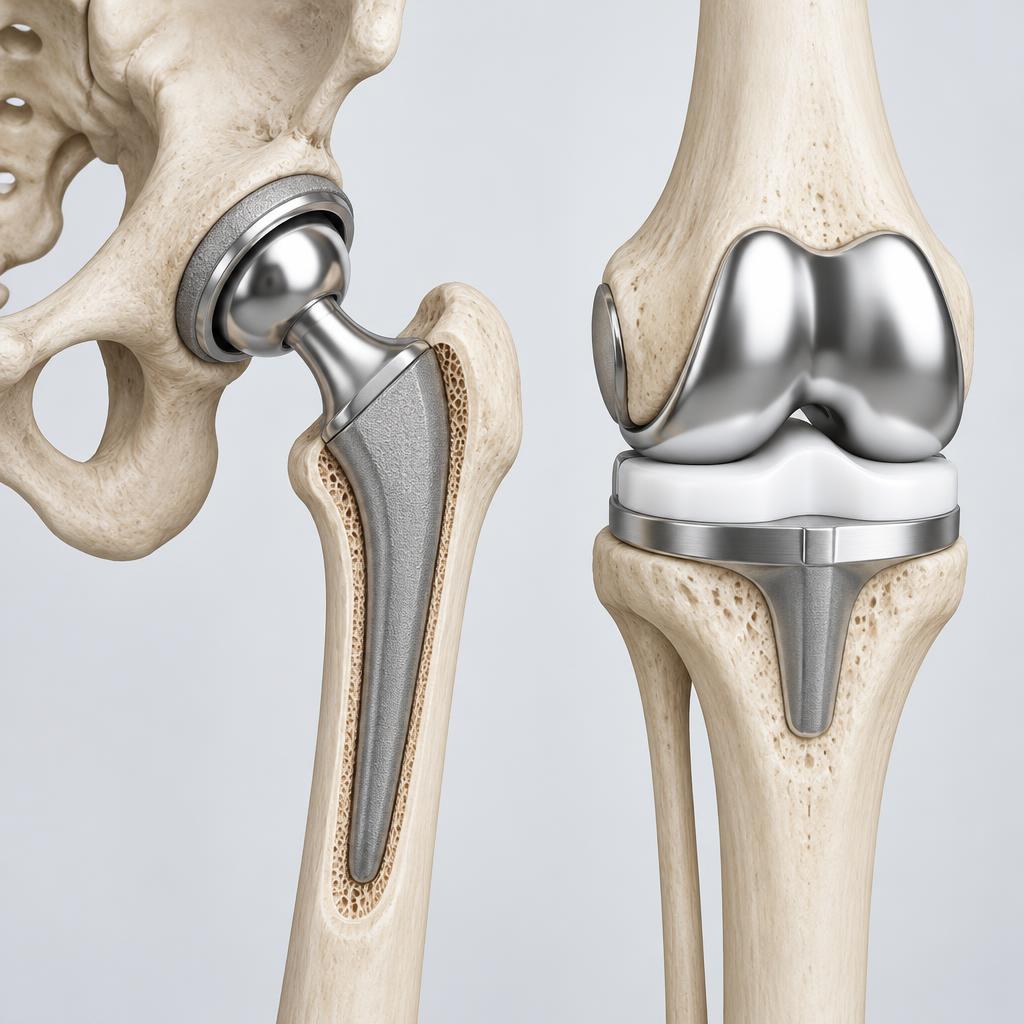
Robotic hip and knee replacement: what the robot really does (and doesn't do)
Short answer
A robot helps me plan and position the implant precisely; I remain in charge throughout. For a typical knee replacement, the best recent UK research shows similar patient outcomes with or without a robot. I find robotic assistance most useful for complex anatomy, old fractures or obstructing metalwork.
No, the robot does not do your operation while your surgeon drinks coffee. And no, your surgeon is not sitting in a corner with a joystick. In hip and knee replacement, a "robot" is a robotic arm that helps the surgeon plan the operation and carry out that plan very precisely. The surgeon is standing at the operating table, in charge, for the whole operation.
The honest answer on results is this: the best and most recent UK research, including a large trial run from University Hospitals Coventry and Warwickshire, shows that for a typical knee replacement, patients do about the same with or without a robot [1–3]. Where I find robots really valuable is in complex cases: unusual anatomy, old fractures, or metalwork in the bone that gets in the way of normal instruments.

Why are people confused about robotic surgery?
Most people have seen the da Vinci robot on TV. It is used for some keyhole operations, such as prostate surgery. The surgeon sits at a console a few metres away and controls tiny instruments inside the body.
Joint replacement robots are different. They are called robotic-arm-assisted systems. The surgeon stands at the table, opens the joint in the usual way and holds or guides the instruments. The robot adds two things:
- A detailed plan of where each part of the new joint should sit.
- Help to carry out that plan accurately, by holding a cutting guide in exactly the right place, or by stopping the saw if it starts to stray outside the planned area.
The robot does not decide what to do. It does not choose your implant. It does not make the operation "keyhole". Your wound will be a similar size to a standard joint replacement.
What does the robot actually do during my operation?
A hip or knee replacement involves removing the worn joint surfaces and fitting new metal and plastic parts. To do that well, the surgeon needs to cut the bone at the right angle and depth, and set the ligaments at the right tension.
This is what a robotic system adds, step by step:
- Mapping your joint. Small markers are fixed to your bones. Cameras track them so the computer always knows where your leg is.
- Planning. The computer shows the surgeon a 3D model of your joint. The surgeon chooses the size and position of each implant.
- Checking the balance (knee). The surgeon moves your knee through its range. The system measures how tight or loose the ligaments are, before any bone is cut.
- Making the cuts. Depending on the system, the robotic arm either holds a cutting guide in place, or the surgeon holds a saw attached to the arm, which will not cut outside the planned area.
- Final checks. The surgeon checks the new joint's movement and stability, as in any joint replacement.
Everything else, such as the anaesthetic, opening the joint, protecting nerves and blood vessels, fitting the implants and closing the wound, is done by the surgical team as normal.
What is the difference between image-guided and imageless robots?
This is one of the most common questions I am asked, and it is the main difference between robotic systems.
Image-guided (image-based) robots use scans taken before surgery. For example, the Mako system uses a CT scan of your hip or knee to build a 3D model of your bones before the day of the operation [12]. The surgeon can plan in detail in advance. ROSA Knee can also build a 3D model from ordinary X-rays [13].
Imageless robots do not need a scan before surgery. During the operation, the surgeon touches key points on your bone with a tracked pointer. The computer builds a model from these points, in real time [13].
| Image-guided | Imageless | |
|---|---|---|
| Scan before surgery | Yes (CT, or X-rays for some systems) | No |
| When the plan is made | Before and during surgery | During surgery |
| Extra radiation | Yes, a CT scan (small dose) | No |
| Best for | Complex or unusual anatomy, old fractures, metalwork | Routine cases, where landmarks are normal |
How are Mako and ROSA different?
I am trained and certified on both Mako (Stryker) and ROSA (Zimmer Biomet). They aim for the same result but work in different ways. The descriptions below are according to the manufacturers and their regulatory documents [12,13].
- Mako (knee and hip). Uses a CT scan to make a 3D plan. In surgery, the surgeon guides the robotic arm, which holds the saw or the hip reamer. The arm creates a "virtual boundary": if the saw tries to go outside the planned cut, it is stopped. In the hip, it also helps to ream the socket and set the cup angle.
- ROSA Knee. Can work imageless, or from X-rays. The robotic arm moves a cutting block into the exact planned position and holds it steady. The surgeon then makes the cut with a saw through the block, as in a standard operation.
- ROSA Hip. Uses X-ray images taken during surgery (anterior approach). The arm holds the socket inserter at the planned angle while the surgeon fits the cup, and it gives measurements for leg length and offset. It does not cut bone [13].
Does robotic surgery give better results?
This is the most important question, so I want to be clear and honest. For the average patient having a routine hip or knee replacement, the best evidence so far shows no meaningful difference in how well people do.
The RACER-Knee trial (The Lancet, 2026). This was a large randomised trial at ten UK hospitals, run by the Warwick Clinical Trials Unit at the University of Warwick and University Hospitals Coventry and Warwickshire NHS Trust [1]. It compared the Mako robot with standard instruments in 339 people having a total knee replacement. To keep it fair, neither the patients nor the people measuring results knew which operation had been done. One year later, both groups scored almost the same on how "normal" their knee felt (49.2 vs 50.2 on the Forgotten Joint Score). Safety was similar. The robotic operation cost more.
The UK National Joint Registry studies (BMJ, 2026). Researchers compared over 22,000 robotic knee replacements and over 10,000 robotic hip replacements with conventional operations in the UK [2,3]. After up to five years, about 98.5 to 98.8 in every 100 joints were still working in both groups. For hips, there was one interesting finding: fewer robotic hips needed redoing because a part was in the wrong position (for example, dislocation or a leg-length difference). A BMJ editorial summed it up: "It is high tech, but is it better?" [4].
The RASKAL trial (Australia, 2026). This trial compared robotic knee surgery with computer navigation, an older computer-guidance technology [5]. At two years, patients did the same with either. The robotic operations were about 11 minutes quicker than navigation.
Other countries' registries. The Dutch registry found no difference in early revision rates [7]. The Australian registry found no overall difference either. However, surgeons who already had higher revision rates before starting to use a robot did not improve, and their later revisions went up [6]. This shows the robot is a tool, not a substitute for experience.
Our own research. With colleagues at UHCW and the University of Warwick, I have studied computer navigation, the forerunner of today's robots, using National Joint Registry data. Across knee and hip replacements, navigation made little or no difference to revision rates or patient scores [9–11].
So why use a robot at all?
Robots are very good at doing exactly what was planned. Studies show they reduce "outliers": the occasional implant placed further from the plan than intended. In theory, fewer outliers should mean fewer problems in the long run. We do not yet know whether that makes a real difference to patients over 15 to 20 years.
The UK health watchdog NICE has said robots can be used in the NHS while more evidence is collected. NICE also noted that for knee replacement, robots may not be good value for money at present [8].
When do I think a robot really helps?
In my practice, robots are most useful when the anatomy is not normal. For example:
- Old fractures that healed in a bent or twisted position, sometimes from childhood.
- Metalwork (plates, nails or screws) from previous surgery that blocks the standard instruments, which often need to go inside the bone.
- Unusual bone shape from birth, or from previous operations such as an osteotomy.
In these cases, an image-guided plan lets us see your exact anatomy in 3D before surgery. We can plan around metalwork and restore alignment, sometimes without removing old implants. A 2026 review found this approach is practical and promising, though the research so far is mostly small case series [14].
Why don't you use a robot for every patient?
For a routine hip or knee replacement, I do not use a robot. The current evidence does not show a benefit for patients, and setting up the robot adds a little time to the operation. I would rather use it where it makes a difference.
The things that matter most for a good result are the same with or without a robot: the right operation for the right patient, an experienced surgeon and team, good implants, and a good recovery plan.
Frequently asked questions
Does the robot do the operation by itself?
No. The surgeon does the operation. The robotic arm helps with planning and holds or guides instruments within the planned limits. It cannot act on its own.
Is robotic knee replacement less painful, with a faster recovery?
The largest UK trial found no meaningful difference in how patients felt one year after surgery [1]. Recovery depends mostly on your health, pain control and physiotherapy.
Is a robotic hip or knee replacement more accurate?
Yes, robots are very precise at making the planned cuts and placing implants. Whether that extra precision leads to better long-term results is still being studied [2–5].
Will my new joint last longer if a robot is used?
We do not know yet. UK registry results up to five years show the same survival for robotic and standard joints [2,3]. Longer follow-up is ongoing.
Do I need a CT scan before robotic surgery?
Only with an image-guided system such as Mako. Imageless systems do not need a scan beforehand.
Is robotic surgery available on the NHS?
Some NHS hospitals offer it. NICE allows its use while more evidence is gathered [8]. Availability varies by hospital.
Should I ask for a robotic operation?
It is a good question to discuss with your surgeon. For most routine operations, the evidence shows similar results either way. It may be particularly helpful if you have unusual anatomy, old fractures or metalwork.
Thinking about a hip or knee replacement?
If you would like to talk about whether a robotic-arm-assisted operation is right for you, I see patients at Nuffield Health Warwickshire Hospital and Circle Health Group Meriden Hospital. You can request an appointment through kozdryk.co.uk.
Request an appointmentThis article is general information and is not a substitute for personal medical advice. Every patient is different; please discuss your own treatment with your surgeon or GP.
References
All checked on PubMed or the original source, 28 October 2026.
- Parsons H, Metcalfe A, Griffin J, et al. Robotic-arm-assisted versus conventional total knee replacement (RACER-Knee): a pragmatic, multicentre, participant-masked and assessor-masked, superiority, randomised controlled trial. Lancet. 2026;408(10558):924–34. https://doi.org/10.1016/S0140-6736(26)00986-4
- Mohammad HR, Judge A, Griffin XL, Murray DW. Early national comparison of robotic versus conventional knee replacements for arthritis using National Joint Registry data: target trial emulation study. BMJ. 2026;394:e100691. https://doi.org/10.1136/bmj-2026-100691
- Mohammad HR, Judge A, Griffin XL, Murray DW. Early national comparison of robotic versus conventional hip replacements for arthritis using National Joint Registry data: target trial emulation study. BMJ. 2026;394:e100709. https://doi.org/10.1136/bmj-2026-100709
- Järvinen TLN, Vänni V, Karjalainen T. Robot assisted hip and knee arthroplasty: it is high tech, but is it better? BMJ. 2026;395:e100981. https://pubmed.ncbi.nlm.nih.gov/42823058/
- MacDessi SJ, Wernecke GC, Ghadirinejad K, et al. Robotic-assisted surgery and functional alignment in total knee arthroplasty: the RASKAL registry-nested 2 × 2 factorial randomized trial. Bone Joint J. 2026;108-B:622–33. https://doi.org/10.1302/0301-620X.108B.BJJ-2025-1472.R2
- Hoskins W, Gusho C, Bingham R, et al. Does transitioning to robotic-assisted total knee arthroplasty change surgeon revision risk or failure modes? JB JS Open Access. 2026;11(2). https://doi.org/10.2106/JBJS.OA.26.00127
- Vink MC, Vossen RJM, Peters RM, et al. No difference in short-term revision risk between robot-assisted total knee arthroplasty and conventional techniques: an analysis of 79,115 total knee arthroplasties in the Dutch arthroplasty register. Knee. 2026;63:104632. https://doi.org/10.1016/j.knee.2026.104632
- National Institute for Health and Care Excellence. Robot-assisted surgery for orthopaedic procedures: early value assessment. HealthTech guidance HTE22. London: NICE; 2025. https://www.nice.org.uk/guidance/hte22
- Farhan-Alanie MM, Gallacher D, Craig P, Griffin J, Kozdryk J, et al. The effects of computer navigation and patient-specific instrumentation on risk of revision, PROMs, and mortality following primary TKR: an analysis of National Joint Registry data. J Bone Joint Surg Am. 2025;107(8):829–39. https://doi.org/10.2106/JBJS.24.00589
- Farhan-Alanie MM, Gallacher D, Craig P, Griffin J, Kozdryk J, et al. Risk of revision and patient-reported outcomes following primary UKR performed using computer navigation or patient-specific instrumentation: an analysis of National Joint Registry data. J Bone Joint Surg Am. 2025;107(15):1659–69. https://doi.org/10.2106/JBJS.24.01483
- Farhan-Alanie MM, Gallacher D, Craig P, Griffin J, Kozdryk J, et al. The effect of computer guided total hip replacement on risk of revision, Oxford Hip Score, and health related quality of life: an analysis of National Joint Registry data. Eur J Orthop Surg Traumatol. 2025;36(1):51. https://doi.org/10.1007/s00590-025-04622-9
- Stryker. Mako SmartRobotics overview [manufacturer information]. https://www.stryker.com/bh/en/joint-replacement/systems/mako-smart-robotics-overview.html
- US Food and Drug Administration. 510(k) summaries K182964 (ROSA Knee System) and K210998 (ROSA Hip System). https://fda.innolitics.com/device/K182964 and https://fda.innolitics.com/device/K210998
- Vu DN, Nguyen TT, Pham TN, et al. Robotic-assisted total knee arthroplasty in post-traumatic and previously operated knees with retained hardware: practical decision-making workflow. J Robot Surg. 2026;20(1). https://doi.org/10.1007/s11701-026-03586-0