Condition
Knee Pain
Arthritis, meniscus tears, ligament injuries, failed knee replacement
Knee pain ranges from sudden injury to long-standing arthritis. A careful assessment defines whether the problem lies in cartilage, meniscus, ligaments or a previous prosthesis — and guides treatment accordingly.
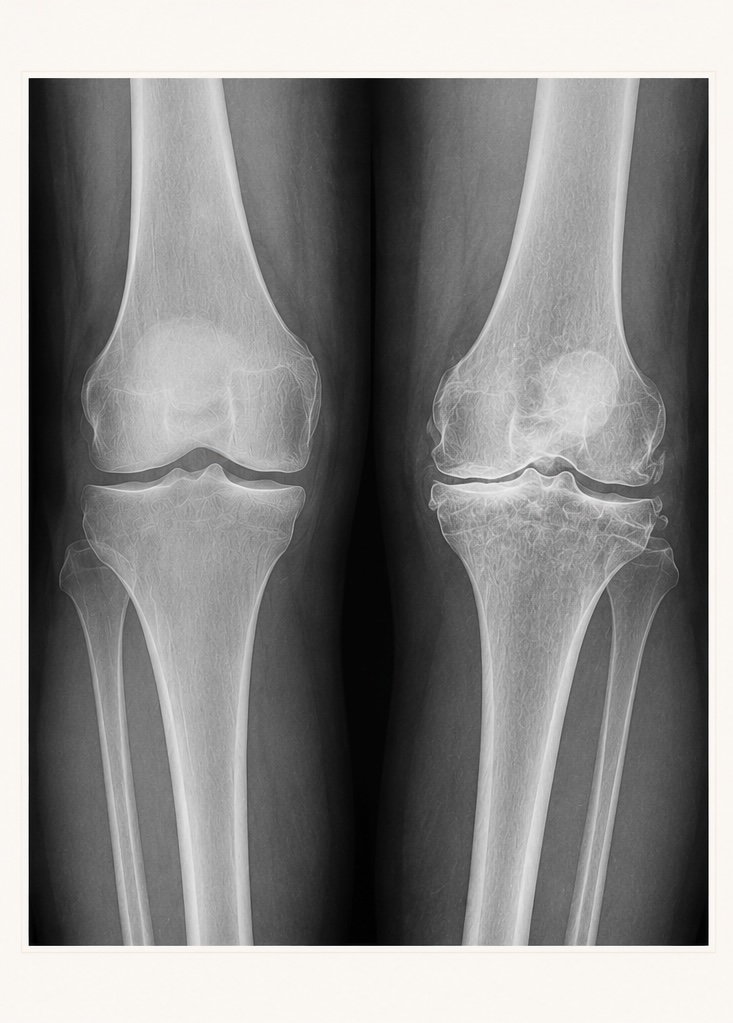 Normal KneeArthritic Knee
Causes of Knee Pain
Osteoarthritis
The most common cause of knee pain in adults — progressive loss of articular cartilage leading to pain, swelling, stiffness and reduced mobility. Can affect one or all three compartments of the knee.
Rheumatoid Arthritis
A chronic inflammatory condition where the immune system attacks the joint lining, causing persistent pain, swelling and progressive joint destruction. Can affect any age and often multiple joints at once.
Meniscal Tears
The menisci are crescent-shaped cartilage shock absorbers. Tears occur acutely from twisting injuries or gradually through wear, causing pain, swelling, catching, clicking or locking.
Ligament Injuries
Injury to the ACL, PCL, MCL, LCL or the quadriceps and patellar tendons can cause instability, pain and loss of confidence in the knee, sometimes requiring reconstruction or repair.
Pain Referred from the Hip
Hip pathology — particularly osteoarthritis — can present as knee pain. A thorough examination of the joint above and below is always part of a knee assessment.
Failed or Painful Knee Replacement
A previous partial or total knee replacement that has become painful — due to loosening, infection, instability, progression of arthritis or stiffness — requires specialist evaluation and may need revision surgery.
Investigations
Detailed clinical assessment of alignment, stability and range of movement, including examination of the hip and ankle to identify referred or contributing pathology
Weight-bearing X-rays as standard, with dedicated patellofemoral views for the kneecap and long-leg alignment views in complex cases
MRI scan to assess the menisci, ligaments and cartilage in detail
CT scan where bony anatomy is complex, metalwork is present, or a painful existing knee replacement requires revision planning
Blood tests including inflammatory markers where an inflammatory or infective cause is suspected
Joint aspiration where infection around a native or prosthetic joint is a possibility
Treatment Options
For most patients the starting point is conservative care, with surgery reserved for cases where it is clearly indicated.
Conservative management
- Physiotherapy, activity modification and weight management to reduce load and improve function
- Bracing and orthotics to support alignment and offload affected compartments
- Injections, joint aspiration and viscosupplementation to manage pain and inflammation
- Arthroscopic surgery for selected acute ligament or cartilage injuries requiring reconstruction or repair
Knee replacement surgery
- Partial knee replacement — for arthritis confined to a single compartment with the rest of the knee well-preserved
- Total knee replacement — for widespread arthritis, including MAKO robotic-arm assisted surgery for greater precision and reproducibility
- Revision knee replacement — for failing or painful previous replacements due to loosening, instability, infection or progression of arthritis
Discuss your knee pain with Mr Kozdryk
Read our patient guide: Knee injections for arthritis: steroid, hyaluronic acid or Arthrosamid?