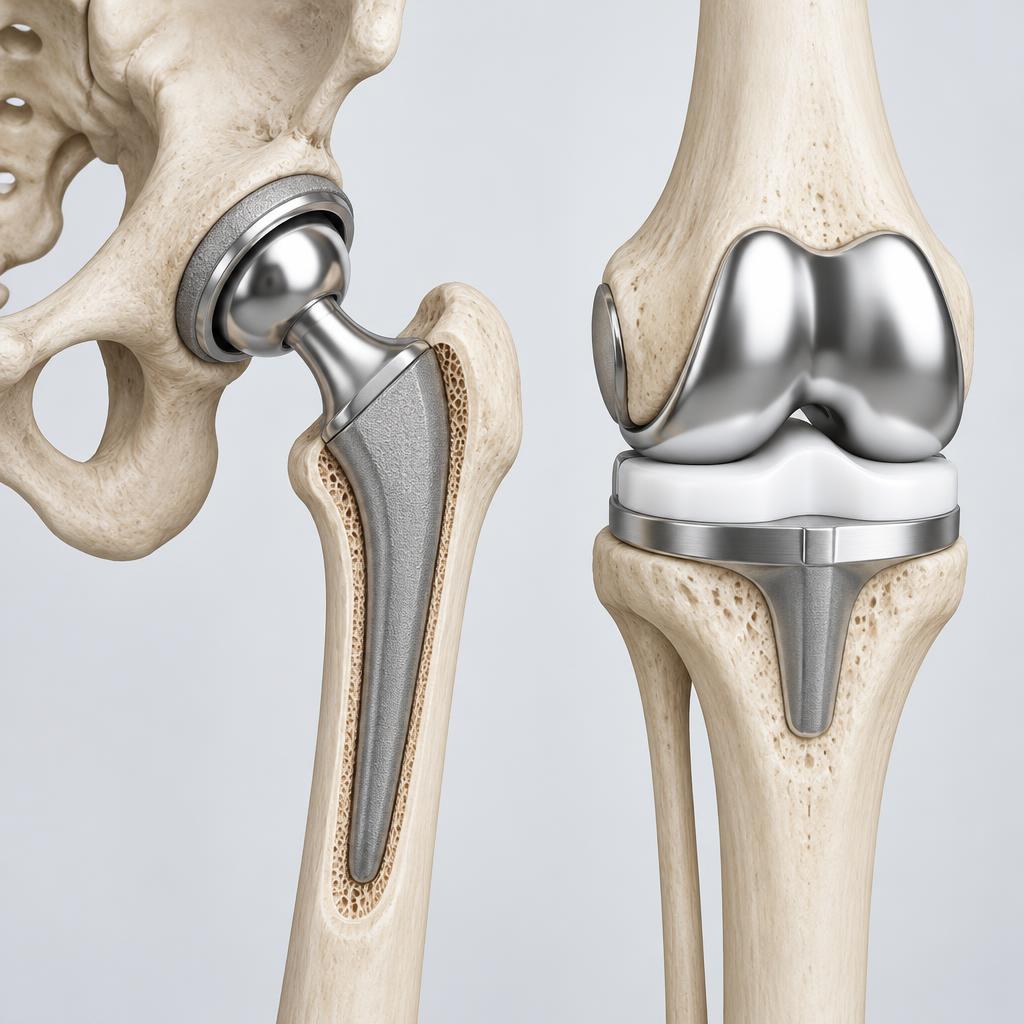
What does a private hip or knee replacement actually cost?
By Mr Jakub Kozdryk, Consultant Trauma & Orthopaedic Surgeon (hip and knee). Medically reviewed by Mr Jakub Kozdryk. Last reviewed: 28 October 2026.
There is no single price, and that is the first thing to understand
If you ask four private hospitals what a hip or knee replacement costs, you will get four different numbers — and the differences will have less to do with the surgery than with what each hospital has chosen to put inside its price.
That makes the headline figures almost impossible to compare. One hospital's number already includes your first consultation; another's does not. One bundles the surgeon and the anaesthetist; another quotes the hospital stay only and leaves the professional fees to be added later. Two quotes that look thousands of pounds apart can end up costing you nearly the same, and two that look identical can diverge once everything is counted.
So the honest answer comes in two parts: a realistic bracket, and an explanation of why that bracket is as wide as it is. Below are the published brackets for the two hospitals where I operate, what sits inside and outside a typical package, and the questions to ask so that the figure you are finally given is one you can rely on.
The brackets at the two hospitals where I operate
I see and operate on private patients at The Meriden Hospital in Coventry, part of Circle Health Group, and at Nuffield Health Warwickshire Hospital in Leamington Spa. Taking the two together, their published self-pay prices in October 2026 sat in these brackets.
| Procedure | Published bracket (October 2026) |
|---|---|
| Total hip replacement | £13,400 – £17,300 |
| Total knee replacement | £14,600 – £16,700 |
| Robotic-assisted hip replacement | £15,400 – £19,800 |
| Robotic-assisted knee replacement | from £16,400 — published at one of the two |
| Partial knee replacement | around £16,200 — published at one of the two |
| Hip resurfacing | around £16,300 — published at one of the two |
Four things need saying about that table.
These are the hospitals' prices, not mine, and the hospitals set and change them independently. They are accurate as published in October 2026 and should be confirmed with the hospital before you rely on them.
The brackets are wide mainly because the two hospitals price on different bases — one builds the consultation into its headline figure, the other quotes the hospital fee and the consultant fee separately. The gap is largely accounting, not surgery.
The bottom of a bracket is not a cheaper operation. It is usually a figure with less loaded into it.
Where a price is published at only one of the two hospitals, that is stated rather than averaged. An invented midpoint would be worse than no number at all.
My own fees
The hospital's charge and my fee are two separate invoices, which is a common source of confusion. Mine are straightforward and I would rather you knew them before you booked anything.
| Self-pay fee | Amount (October 2026) |
|---|---|
| Initial consultation | £200 |
| Follow-up consultation | £150 |
| Injection procedure | £150 |
Those are invoiced by my practice and are separate from whatever the hospital charges for the facility, the implant or the stay. If you are using insurance, your policy and your excess determine what you pay rather than this list.
The formal quotation for an operation comes from the hospital rather than from me. They hold the package prices, the figures differ between the two sites, and the quote is issued in writing once I have seen you and agreed what you need. Ask my secretary and I will put you in touch with the right self-pay team.
What a package price usually covers
Most private hospitals now sell joint replacement as a fixed-price package rather than itemising every element. A typical package covers the operation itself, the theatre time and nursing care, a standard implant, the drugs and dressings used during your stay, and a set number of nights in hospital.
Beyond that it varies. Depending on the hospital, the package may also include some or all of these:
- the surgeon's fee and the anaesthetist's fee
- a set number of post-operative follow-up appointments
- a course of physiotherapy, sometimes with the number of sessions specified and sometimes not
- a period of cover if something goes wrong and further treatment is needed
Every one of those four is worth confirming in writing, because each is included somewhere and excluded somewhere else. "Physiotherapy included" can mean a full rehabilitation programme or it can mean the sessions you have on the ward before you go home.
What usually sits outside it
The costs that catch people out are the ones that come before and after the operation rather than during it.
The first consultation is the most common exclusion. You pay for that appointment separately at many hospitals, and it is charged whether or not you go on to have surgery. If you then need an X-ray, an MRI or blood tests to decide whether a replacement is the right answer, those are usually charged separately too.
After surgery, the things most often outside the package are extended physiotherapy beyond whatever is included, any aids or equipment you take home, and follow-up appointments beyond the number specified. None of these is large on its own. Together they are worth knowing about before you commit, not afterwards.
The surgeon's fee and the anaesthetist's fee
These are the two elements patients find hardest to pin down, because hospitals handle them in opposite ways.
Where a hospital operates a true package, the surgeon and anaesthetist are paid out of the single price you are quoted, and you never see the split. Where it does not, the hospital price covers the facility and your stay, and the professional fees are quoted separately — sometimes as a firm figure, sometimes as a starting point that depends on which consultant you choose.
This is also why comparing consultants on published fees is harder than it looks: where the hospital bills a single package, there is often no separate consultant fee to publish in the first place.
You are not left guessing, though. A consultant recommending private treatment should give you a written estimate of what the whole pathway will cost, together with a statement of anything that estimate does not include — and the anaesthetist's fee is the example the regulator itself gives. If you have not been given that, ask for it.
Why two hospitals quote such different numbers
The gap between quotes is mostly a difference in accounting, not in the quality of your operation.
Four things drive it. First, what the price includes, as above — the single biggest reason two numbers are not comparable. Second, where the hospital is: prices in and around London sit well above the rest of the country, and there is real variation between regions and even between neighbouring towns. Third, whether the figure is a fixed quote or a "from" price, which is the lowest case and can rise once your own circumstances are assessed. Fourth, the hospital's own position in its local market.
What the difference rarely reflects is the implant, the operation or the standard of care. A joint replacement in a private hospital is the same operation done by the same consultants who do it in the NHS, usually with implants chosen from the same small group of well-evidenced designs. A higher price does not buy a better hip.
Robotic assistance, implants and other add-ons
Robotic-assisted surgery is the add-on patients ask about most. Some hospitals price it the same as a conventional replacement, some charge a premium for it, and some do not publish a separate figure at all. If it matters to you, ask whether it carries an extra charge at that hospital and what the charge covers, including the pre-operative scan that robotic planning often requires.
Implants work differently from how people expect. Packages include a standard implant, and standard here means a well-established design with good long-term registry data — not a basic one. A surcharge arises only in the unusual case where your anatomy or a previous operation calls for something non-standard or custom-made, and you would be told about that in advance.
On the robot specifically, my own view is one the evidence now supports. The RACER-Knee trial (Robotic Arthroplasty Clinical and Cost Effectiveness Randomised Controlled Trial) was led in the United Kingdom and coordinated by the Warwick Clinical Trials Unit at the University of Warwick, University Hospitals Coventry and Warwickshire (UHCW) NHS Trust, where I work, and the Royal Orthopaedic Hospital in Birmingham. Run across ten NHS hospitals, it compared robotic-assisted with conventional knee replacement in a blinded randomised trial. The robot placed the implant more precisely. A year later, patients could not tell the difference, and neither could their scores. For a straightforward first-time knee replacement, I would not advise anyone to pay a premium for it.
Where I do use robotic assistance is in the cases that genuinely stand to gain: significant deformity outside the joint, maltracking, anatomy that makes conventional instruments unreliable. That is a clinical judgement about your particular joint, not an upgrade to be sold to you. The implant is the same principle — chosen on registry evidence and on what your joint needs, never bought up or down on price.
What can change the price after you have been quoted
A fixed quote given after a proper assessment should be the price you pay. The question is what happens if your recovery does not follow the usual course.
Most hospitals offer some form of cover for complications arising from the surgery — further treatment at no additional cost, for a defined period and within defined limits. The period and those limits differ, so read what it actually promises. Cover for a complication of the operation is not the same as cover for an unrelated medical problem that happens to surface while you are in hospital.
The other variable is length of stay. Packages assume a standard number of nights, and if you need longer there may be a nightly charge, though many hospitals absorb it where the reason is clinical. Ask what happens if you stay an extra night, and ask before you are lying in the bed.
Insurance and self-pay are two different conversations
If you have private medical insurance, the price lists above are largely beside the point. Your insurer negotiates its own rates, and what matters to you is whether your policy covers joint replacement, whether the arthritis counts as a pre-existing condition, what excess you pay, and whether your consultant and hospital are recognised by that insurer. Authorisation is obtained before surgery, not after.
The gap to watch is the shortfall: where a consultant's fee exceeds what the insurer pays, the difference is yours. Ask both the insurer and the consultant's secretary whether any shortfall is expected, and get the answer before the date is booked.
If you are self-funding, ask for a written, itemised quote and treat it as you would any other significant purchase. Most hospitals also offer finance arrangements spreading the cost over a period, which can be worth asking about.
If you are weighing up an injection instead
Not everyone reading this is ready for a replacement, and an injection is sometimes a reasonable way to buy time. It is priced quite differently, so it is worth separating out.
My own fee for an injection procedure is £150, on top of the £200 consultation. I perform all injections myself, in clinic, under local anaesthetic, and I will want a clinic review and an up-to-date X-ray first — so the consultation is part of the process rather than an optional extra. What varies far more than my fee is the hospital's charge for the drug or device itself. A steroid injection costs very little. A hyaluronic acid preparation costs more. Arthrosamid, which is a hydrogel device rather than a drug, costs substantially more again — between £2,500 and £3,000 for a single knee (prices as of 28 October 2026), covering the procedure fee and the cost of the injection. The two hospitals come out within a little of each other on it. The £200 consultation is not part of that figure and is charged separately.
Neither hospital lists Arthrosamid on its published price list, so ask for the figure in writing when you enquire rather than afterwards. For comparison, the private providers in the UK that do publish an Arthrosamid price mostly sit between about £2,800 and £3,650 for a single knee, with the consultation charged on top of that.
Which injection makes sense, if any, is a separate question from what it costs, and I have written about that elsewhere on this site.
Ten questions to ask before you commit
Take these to any hospital or consultant you are considering. The answers, in writing, turn a headline number into something you can compare.
- Is this a fixed price or a "from" price, and what would make it change?
- Does it include my first consultation, and any scans or tests needed to plan the surgery?
- Does it include the surgeon's fee?
- Does it include the anaesthetist's fee?
- How many nights are included, and what happens if I need to stay longer?
- How many follow-up appointments are included, and over what period?
- Is physiotherapy included — how many sessions, where, and for how long?
- What cover is there if a complication of the surgery needs further treatment, and for how long does it last?
- Is there any charge for robotic assistance or for the implant you plan to use?
- Is there anything else I am likely to be billed for that is not on this quote?
If a question gets a vague answer, that is itself useful information. A hospital that is confident in its pricing will put all ten in writing without hesitation.
Getting a figure you can rely on
The only number that means anything is the one written for you, after someone has looked at your X-rays and examined your joint. Until then, every figure you read online is a starting point for a conversation.
It is also worth saying that a replacement is not always the answer. Part of what a consultation establishes is whether your arthritis has reached the stage where surgery is the right step, or whether there is something sensible to try first. That conversation costs you the price of an appointment and can save you a great deal more.
If you would like a clear written quote for your own situation, including exactly what is and is not included, please get in touch and I will set out the figures properly.