Knee injections for arthritis: steroid, hyaluronic acid or Arthrosamid?
By Mr Jakub Kozdryk, Consultant Trauma & Orthopaedic Surgeon (hip and knee). Medically reviewed by Mr Jakub Kozdryk. Last reviewed: 4 October 2026.
If you have a painful, arthritic knee, you have probably heard about knee injections for arthritis: steroid (often called "cortisone"), hyaluronic acid (the "gel" or "lubricating" injection) and Arthrosamid. The honest short answer is that no injection cures arthritis or grows new cartilage, and none works for everyone. A steroid injection can ease pain for a few weeks. For hyaluronic acid and Arthrosamid the research is mixed: on average the benefit is modest or uncertain, but some people do find them helpful, and they can be a reasonable way to manage symptoms for a while if you are not ready for, or do not want, surgery.[1–4]
For most people, the treatments that make the biggest long-term difference are exercise tailored to you, and losing weight if needed.[1] An injection can be a useful addition, for example to calm a flare-up or keep you active while you decide on the next step.
What does an injection actually do to an arthritic knee?
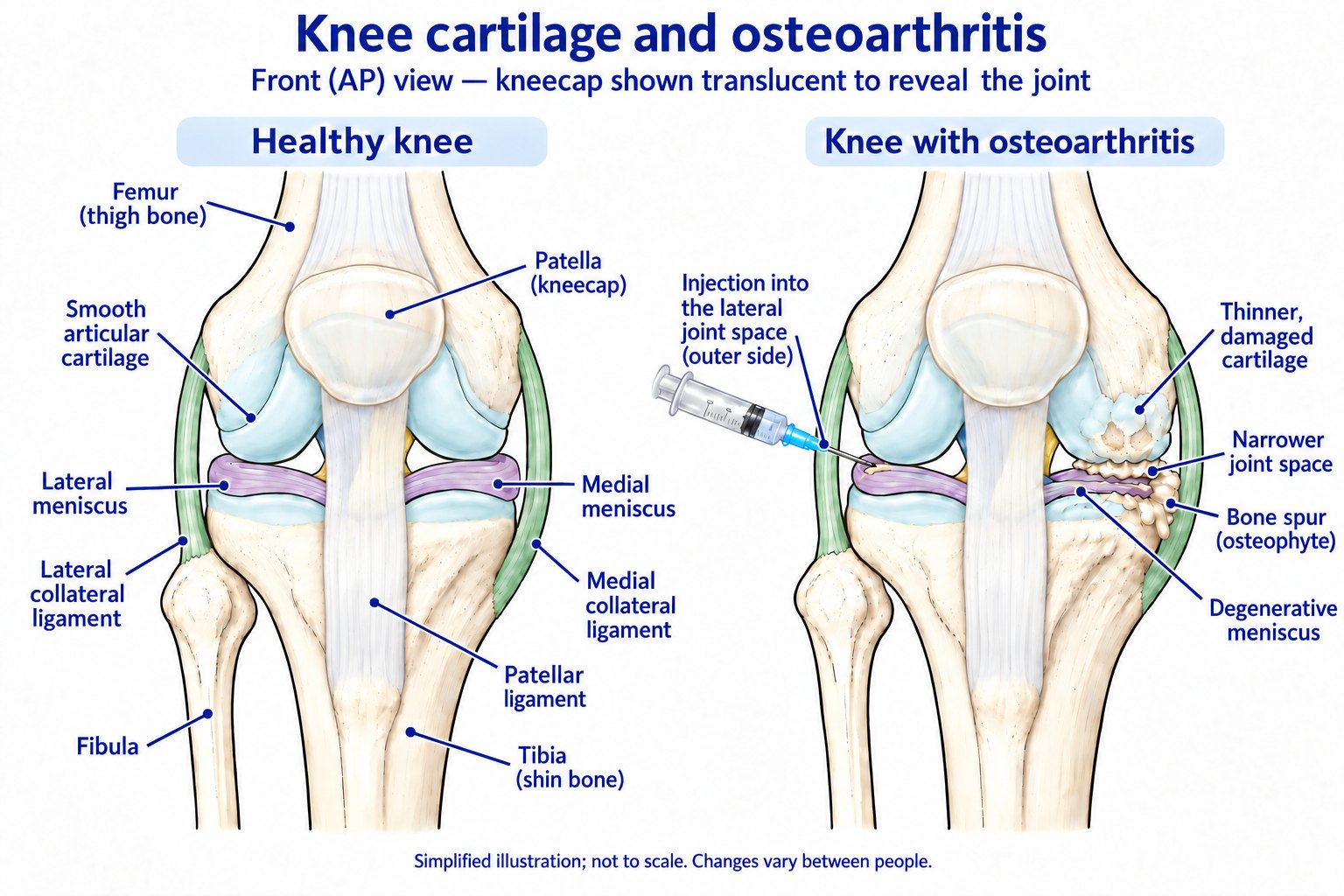
In osteoarthritis, the smooth covering on the ends of the bones (cartilage) becomes thinner and rougher, and the lining of the joint (the synovium) can become inflamed, causing swelling and pain. Knee injections go straight into the joint (an intra-articular injection) and aim to reduce pain and swelling. None has been shown to reverse the wear.
What does NICE say about knee injections for arthritis?
What is NICE, and why does it matter?
NICE (the National Institute for Health and Care Excellence) is a public body that gives national guidance on health and care in England. Its recommendations are written by independent committees, which include patients or carers, based on the best available evidence and, for most guidelines, value for money.[5] This matters because NICE weighs up all the research, not just one encouraging study, and its guidance shapes which treatments the NHS provides. But it describes what works best on average for large groups of people, and NICE itself says its recommendations are not mandatory and do not override decisions made with an individual patient.[1]
What NICE says about knee arthritis
NICE's current osteoarthritis guideline, published in October 2022, says:[1]
- Exercise: offer therapeutic exercise, tailored to the person, to everyone with osteoarthritis.[1]
- Weight: if you are overweight, losing weight will improve pain, function and quality of life.[1]
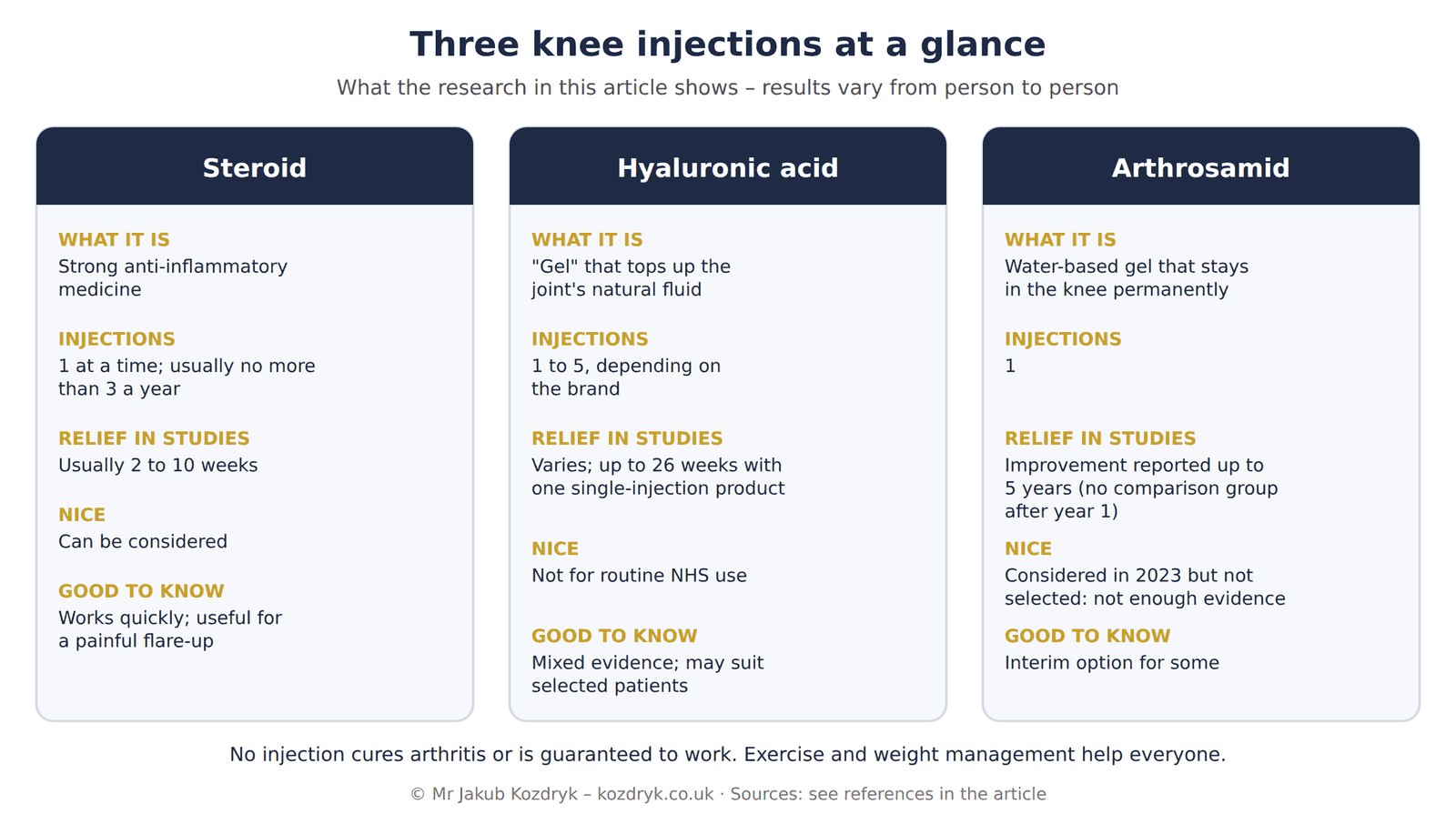
- Steroid injections: can be considered when other pain medicines have not worked or are not suitable; relief is short term, about 2 to 10 weeks.[1]
- Hyaluronic acid injections: not to be offered on the NHS. Based on the evidence available in 2022, NICE concluded there was not enough evidence of benefit to support their routine, large-scale use.[1]
- Arthrosamid: NICE considered it in 2023 but decided not to develop guidance, because there was not enough evidence at that time.[6]
That is why some specialists, including me, offer certain treatments that NICE does not recommend for routine NHS use to carefully selected patients.
NICE also says that if your knee is having a big impact on your quality of life and non-surgical treatment is not working or not suitable, your doctor should consider referring you for a joint replacement.[1]
Steroid ("cortisone") injections
What is it?
A steroid injection contains a strong anti-inflammatory medicine, often mixed with local anaesthetic. It works by calming the inflamed joint lining. It is not the same as the steroids some athletes misuse.
Does it work?
A Cochrane review (a high-quality summary of all the trials) looked at 27 studies with 1,767 people.[2] Steroid injections reduced pain more than a dummy injection, but the effect faded over time: it was moderate at 1 to 2 weeks, small by about 3 months, and there was no clear benefit at 6 months. Roughly 1 in 8 people had a worthwhile improvement they would not otherwise have had. The reviewers rated the quality of the evidence as low, because the trials varied a lot and many were small.[2]
What about having them again and again? In a two-year trial, people were given either a steroid injection or salt water (saline) into the knee every 3 months. The steroid group did not have less pain than the saline group, and MRI scans showed slightly more cartilage loss in the steroid group.[7] This is one reason most doctors limit how often they give them.
What to expect
The patient leaflet used at University Hospitals Coventry and Warwickshire (UHCW) gives practical guidance:[8]
- The injection may start to work within 24 hours, or may take up to 3 weeks. The effect usually lasts up to 3 months.
- Usually no more than 3 injections a year into the same area, at least 8 weeks apart.
- Pain can increase for 24 to 48 hours afterwards in some people (between 2 and 25 in 100). Facial flushing happens in 10 to 15 in 100.
- Infection is rare: about 1 in 17,000.
- If you have diabetes, check your blood sugar closely for 7 days, as steroids can raise it.
- Avoid intense activity with the knee for a week.
Steroid injections and future joint replacement
A large review of studies, including over 480,000 patients, found a higher risk of infection after hip replacement in people who had a steroid injection beforehand, especially within 3 months of surgery. It did not find a clear link for knee replacement.[9] Even so, many surgeons prefer to leave a gap between an injection and surgery.
In my view, 2 to 3 steroid injections a year in early arthritis is reasonable. Even if the arthritis progresses a little over time, this does not stop someone having a successful knee replacement later, and less pain in the meantime is a real benefit. I also use steroid injections to control symptoms in people with more advanced arthritis who are not ready for a knee replacement, physically or emotionally, or whose work, family or other circumstances mean they cannot have major surgery and take time off to recover at the moment.
Hyaluronic acid ("gel" or "lubricating") injections
What is it?
Hyaluronic acid (hyaluronan) is a natural part of the fluid that lubricates your joints, and the injection ("viscosupplementation") aims to top this up. Depending on the brand, it is given as one to five injections, usually a week apart.[10] According to its manufacturer, Durolane is a single-injection product that can give up to 26 weeks of pain relief.[11]
Does it work?
The research is genuinely mixed.
- In favour: a 2006 Cochrane review of 76 trials concluded that hyaluronic acid improved pain and function, especially 5 to 13 weeks after injection, although the benefit varied between products.[12]
- Against: a larger 2022 BMJ review (169 trials, over 21,000 people) found that in the largest, best-run trials the average pain reduction compared with a dummy injection was very small, about 2 points on a 100-point scale, with a slightly higher rate of serious side effects.[3]
- Single-injection products: in a trial of 442 people, one Durolane injection worked as well as a steroid injection at 12 weeks, and its benefit lasted to 26 weeks while the steroid's faded.[13] In another trial it did no better than a dummy injection overall at 6 weeks, but in people whose knee was not swollen with fluid, more improved with Durolane (41 in 100) than with the dummy (20 in 100). This was spotted after the trial ended (a "post-hoc" finding), so it needs confirming.[14]
An average across thousands of people does not tell us whether a smaller group benefits more, and we cannot yet reliably predict who will respond.
How I use it
I consider hyaluronic acid for people with early arthritis, whether or not their knee is in a flare-up, whose moderate symptoms stop them doing sport or other activities they value. They are usually not ready for a joint replacement, and keyhole (arthroscopic) surgery would not help. For them, it can be a reasonable interim way to manage symptoms. I explain that it does not work for everyone and there is no guarantee of improvement; the decision is the patient's.
Arthrosamid (polyacrylamide hydrogel)
What is it?
Arthrosamid is a gel made of 97.5% water and 2.5% polyacrylamide, given as a single injection into the knee.[15] According to the manufacturer, it is "non-biodegradable", so it stays in the knee;[16] it becomes part of the joint lining over 4 to 6 weeks, making the lining more elastic, and relief builds over 4 to 12 weeks.[17] Independent reviewers say exactly how it eases pain is not yet fully understood.[15]
According to the manufacturer, it is given under local anaesthetic, usually with antibiotics beforehand, and you go home the same day. It should not be used if the knee is infected or severely inflamed, if you have a knee replacement or other foreign material in the knee, after keyhole knee surgery in the last 6 months, or with haemophilia or poorly controlled blood-thinning treatment.[17]
Does it work?
The main trial, in Denmark, compared a single Arthrosamid injection with a single hyaluronic acid injection in 239 adults.[4] After 6 months, pain had improved by a similar amount in both groups (about 18 and 15 points on a 0 to 100 scale). Side effects, mostly mild or moderate pain or swelling in the knee, were more common after Arthrosamid (29 in 100 people) than after hyaluronic acid (8 in 100).[4] According to the manufacturer's own analysis of this trial, 73 in 100 people treated with Arthrosamid reported less pain at one year.[17]
Of the 119 people who had Arthrosamid, 58 were still being followed at 5 years. On average their pain scores were about 16 points better than before treatment, with no new side effects linked to the gel.[18] This is encouraging, but by then there was no comparison group and about half the original group had left the study, so we cannot be sure how much of the improvement was due to the injection.
What we don't know yet
- No dummy-injection trial yet. The main trial compared it with hyaluronic acid, whose own benefit over a dummy injection is debated.[3] I found no published placebo-controlled trial (October 2026).
- Most research comes from one team.[4,18]
- Independent reviewers are cautious. A 2026 UK review found it does seem to improve symptoms, but said study quality and long-term evidence are not yet strong enough for routine use.[15]
- It is permanent, so it is worth discussing what this means if you later need a knee replacement.
How I use it
For some patients with moderate arthritis (grade 2 to 3 on X-ray) whose symptoms are troublesome but not severe, I discuss Arthrosamid as an interim option before surgery. I give them the manufacturer's leaflet and explain both the encouraging results and the gaps in the evidence. There is no guarantee it will help, and the choice is theirs.
Why consider joint-preserving treatments at all?
Knee replacement is a very effective operation for many people with advanced arthritis, but it is not perfect. In a Canadian study of over 1,700 knee replacements, about 4 in 5 people were satisfied and about 1 in 5 were not.[19] In the best-quality studies, about 1 in 5 people still had troublesome long-term pain after knee replacement, and around 1 in 10 after hip replacement.[20] So with early or moderate arthritis, it often makes sense to try non-surgical, joint-preserving options first, with realistic expectations. No treatment, from an injection to a joint replacement, comes with a guarantee.
So which knee injection is best for me?
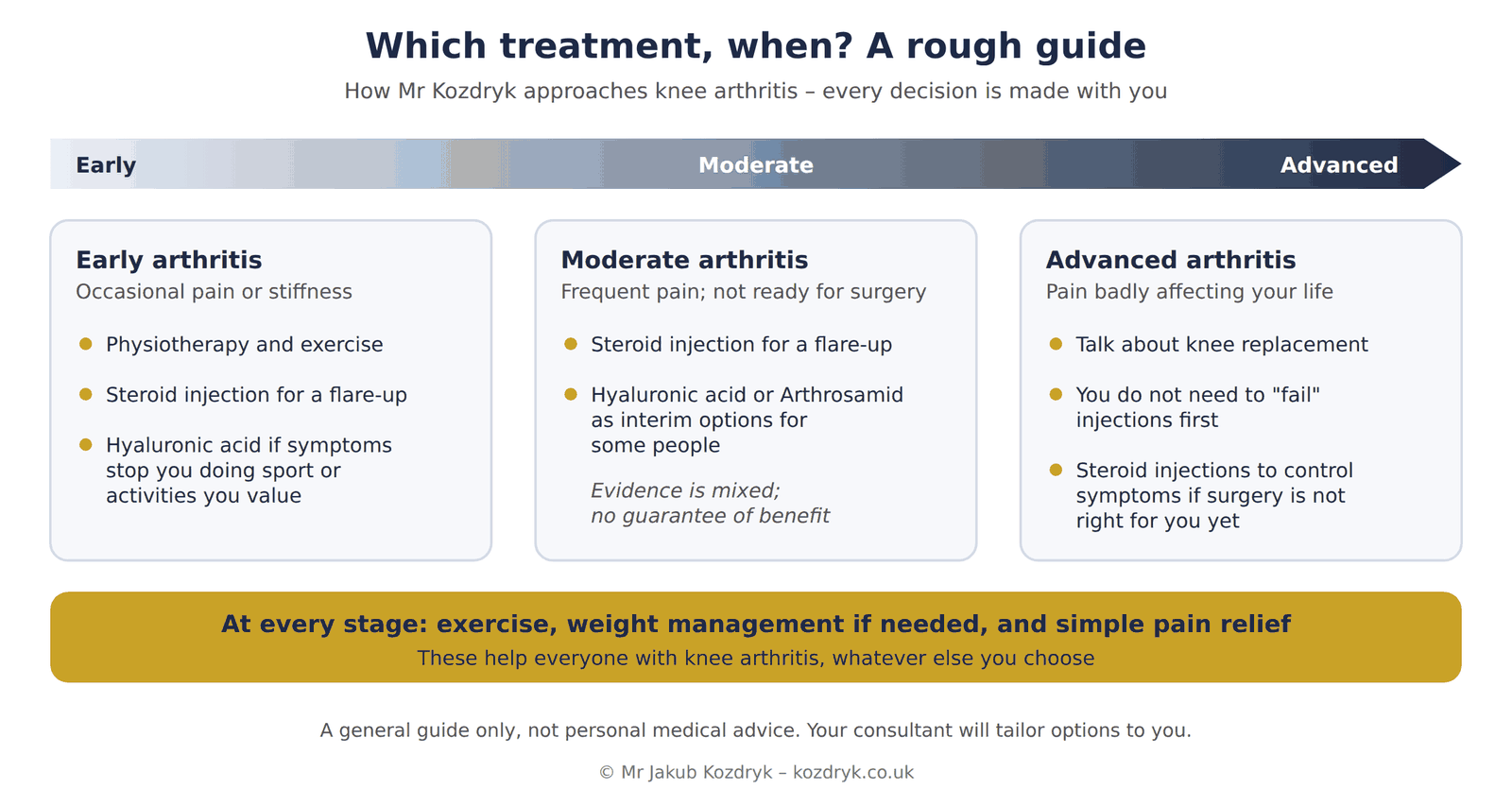
There is no single best injection for everyone: it depends on your knee, your goals and your other health conditions. As a rough guide to how I approach it:
- For everyone: exercise, weight management where needed, and simple pain relief.[1]
- A painful flare-up: a steroid injection can settle things for a few weeks;[1,2] hyaluronic acid is an alternative for some people.
- Early to moderate arthritis, where symptoms stop you doing things you value: hyaluronic acid or Arthrosamid may be reasonable interim options for some people, accepting that the evidence is mixed.
- Advanced arthritis that is badly affecting your life: it is reasonable to talk about a knee replacement. You do not need to "fail" a series of injections first.[1] If surgery is not right for you yet, steroid injections can help in the meantime.
When to get urgent help after a knee injection
Infection after a joint injection is rare, but serious. Seek urgent medical help if, in the days after an injection, your knee becomes increasingly hot, red, swollen and painful, or you feel feverish or unwell.[8] Do not wait for your next appointment.
Frequently asked questions
How long does a steroid injection in the knee last?
Usually a few weeks. NICE says to expect short-term relief of about 2 to 10 weeks.[1] The UHCW leaflet says the effect usually lasts up to 3 months.[8] Some people get little or no benefit.[2]
How many steroid injections can you have in your knee?
There is no fixed national limit, but a common rule is no more than 3 a year in the same joint, at least 8 weeks apart.[8]
My knee hurts more after my cortisone injection. Is that normal?
A short-lived increase in pain for 24 to 48 hours can happen (a "steroid flare").[8] It should settle. If the knee becomes hot, red and increasingly swollen, or you feel unwell, seek urgent help, as these can be signs of infection.[8]
Why won't the NHS give me hyaluronic acid injections?
Based on the evidence available in 2022, NICE concluded there was not enough evidence of benefit to support their routine, large-scale use on the NHS.[1] Some specialists still offer it to selected patients. The research is mixed.[3,12,13]
Does Arthrosamid really work? Is it worth it?
In the main trial it worked about as well as hyaluronic acid, with lasting improvement reported in many patients.[4,18] It has not yet been compared with a dummy injection, and independent reviewers advise caution.[15] For some people with moderate symptoms it is a reasonable option to discuss with a specialist.
Is Arthrosamid available on the NHS?
NICE considered Arthrosamid in August 2023 but did not select it for guidance, because there was not enough evidence at that time.[6] More trial results have been published since.[4,18]
Will an injection stop me needing a knee replacement?
No injection has been shown to stop arthritis getting worse.[1,2,7] If your knee is badly affecting your life and other treatments are not helping, it is reasonable to discuss surgery.[1]
Talk to a knee specialist in Coventry and Warwickshire
If you would like to discuss whether an injection, physiotherapy or knee surgery is right for you, Mr Kozdryk sees patients at Nuffield Health Warwickshire Hospital and Circle Health Group Meriden Hospital. Find out more about knee injections and knee pain, or get in touch to arrange a consultation.
References
- National Institute for Health and Care Excellence. Osteoarthritis in over 16s: diagnosis and management. NICE guideline NG226. London: NICE; 19 Oct 2022. Available from: https://www.nice.org.uk/guidance/ng226 (recommendations 1.3.1, 1.3.5, 1.4.9, 1.4.10, 1.6.1; rationale and 'Your responsibility' statement). Also via NCBI Bookshelf: https://www.ncbi.nlm.nih.gov/books/NBK588843/
- Jüni P, Hari R, Rutjes AW, Fischer R, Silletta MG, Reichenbach S, et al. Intra-articular corticosteroid for knee osteoarthritis. Cochrane Database Syst Rev. 2015;(10):CD005328. doi:10.1002/14651858.CD005328.pub3. PMID: 26490760.
- Pereira TV, Jüni P, Saadat P, Xing D, Yao L, Bobos P, et al. Viscosupplementation for knee osteoarthritis: systematic review and meta-analysis. BMJ. 2022;378:e069722. doi:10.1136/bmj-2022-069722. PMID: 36333100.
- Bliddal H, Beier J, Hartkopp A, Conaghan PG, Henriksen M. Polyacrylamide gel versus hyaluronic acid for the treatment of knee osteoarthritis: a randomised controlled study. Clin Exp Rheumatol. 2024;42(9):1729-35. doi:10.55563/clinexprheumatol/i3fqee. PMID: 38525999.
- National Institute for Health and Care Excellence. Developing NICE guidelines: the manual. Process and methods PMG20, chapter 1: Introduction. London: NICE; 2014 (last updated). Available from: https://www.nice.org.uk/process/pmg20/chapter/introduction [accessed 4 Oct 2026].
- National Institute for Health and Care Excellence. Arthrosamid for symptomatic treatment of knee osteoarthritis. Topic prioritisation GID-MT606: decision 'Not selected' – not eligible for HealthTech evaluation guidance, insufficient evidence. London: NICE; 16 Aug 2023. Available from: https://www.nice.org.uk/guidance/prioritisation/gid-mt606 [accessed 4 Oct 2026].
- McAlindon TE, LaValley MP, Harvey WF, Price LL, Driban JB, Zhang M, et al. Effect of intra-articular triamcinolone vs saline on knee cartilage volume and pain in patients with knee osteoarthritis: a randomized clinical trial. JAMA. 2017;317(19):1967-75. doi:10.1001/jama.2017.5283. PMID: 28510679.
- University Hospitals Coventry and Warwickshire NHS Trust. Physiotherapy and steroid injections [patient information leaflet]. Coventry: UHCW; June 2022. Available from: https://www.uhcw.nhs.uk/download/clientfiles/files/Patient%20Information%20Leaflets/Clinical%20Support%20Services/Therapies/Physiotherapy/Physiotherapy%20and%20steroid%20injections.pdf
- Albanese J, Feltri P, Boffa A, Werner BC, Traina F, Filardo G. Infection risk increases after total hip arthroplasty within 3 months following intra-articular corticosteroid injection. A meta-analysis on knee and hip arthroplasty. J Arthroplasty. 2023;38(6):1184-93.e2. doi:10.1016/j.arth.2022.12.038. PMID: 36592824.
- Arthritis UK (formerly Versus Arthritis). Hyaluronan injections [patient information]. Available from: https://www.arthritis-uk.org/information-and-support/understanding-arthritis/arthritis-treatments/drugs/hyaluronan-injections/ [accessed 24 Sep 2026].
- Bioventus. DUROLANE: help relieve painful knee osteoarthritis (OA) with a single-injection treatment [manufacturer patient brochure]. Bioventus; undated. Manufacturer source – used only for the product description.
- Bellamy N, Campbell J, Robinson V, Gee T, Bourne R, Wells G. Viscosupplementation for the treatment of osteoarthritis of the knee. Cochrane Database Syst Rev. 2006;(2):CD005321. doi:10.1002/14651858.CD005321.pub2. PMID: 16625635.
- Leighton R, Akermark C, Therrien R, Richardson JB, Andersson M, Todman MG, et al. NASHA hyaluronic acid vs. methylprednisolone for knee osteoarthritis: a prospective, multi-centre, randomized, non-inferiority trial. Osteoarthritis Cartilage. 2014;22(1):17-25. doi:10.1016/j.joca.2013.10.009. PMID: 24185114.
- Arden NK, Åkermark C, Andersson M, Todman MG, Altman RD. A randomized saline-controlled trial of NASHA hyaluronic acid for knee osteoarthritis. Curr Med Res Opin. 2014;30(2):279-86. doi:10.1185/03007995.2013.855631. PMID: 24168077.
- Farhan-Alanie MM, Brown S, Wright K, Snow M. Efficacy of novel polyacrylamide hydrogel injection for osteoarthritis. Knee. 2026;62:104492. doi:10.1016/j.knee.2026.104492. PMID: 42150308.
- Contura Orthopaedics. Arthrosamid: results [manufacturer information for healthcare professionals]. Available from: https://hcp.arthrosamid.com/results [accessed 24 Sep 2026]. Manufacturer source – used only for the product description "non-biodegradable".
- Contura Orthopaedics. Arthrosamid: stop pain getting in the way – lasting relief for knee osteoarthritis [manufacturer patient brochure]. Ref. OUS/ARTHRO/JUL026/096. Contura Orthopaedics Ltd; 2026. Manufacturer source – used for product description, procedure, contraindications and the manufacturer's own analysis of reference 4.
- Bliddal H, Beier J, Hartkopp A, Conaghan PG, Henriksen M. Sustained symptom relief and safety over five years following a single intra-articular injection of 2.5% polyacrylamide hydrogel in patients with knee osteoarthritis. Clin Exp Rheumatol. 2026;44(7):1410-7. doi:10.55563/clinexprheumatol/bsper8. PMID: 41779591.
- Bourne RB, Chesworth BM, Davis AM, Mahomed NN, Charron KD. Patient satisfaction after total knee arthroplasty: who is satisfied and who is not? Clin Orthop Relat Res. 2010;468(1):57-63. doi:10.1007/s11999-009-1119-9. PMID: 19844772.
- Beswick AD, Wylde V, Gooberman-Hill R, Blom A, Dieppe P. What proportion of patients report long-term pain after total hip or knee replacement for osteoarthritis? A systematic review of prospective studies in unselected patients. BMJ Open. 2012;2(1):e000435. doi:10.1136/bmjopen-2011-000435. PMID: 22357571.